


How To Measure The Key Areas Of Your Event Attendees’ Carbon Footprint
Updated: Jun 3
Measuring event sustainability can feel daunting to anyone tackling it for the first time, with so many areas to stay on top of.
Every attendee decision shapes your event’s environmental footprint. What they eat, which sessions they attend, how they travel to your venue, and what waste they generate.
By understanding which data matters most, where to collect it, and how to use it, we can create clearer reporting and stronger sustainability strategies over time.
In this guide, we’ll walk you through the key areas of event guest sustainability data so you can feel more confident in taking it on.
Why Attendee Carbon Footprint Reporting Matters
Attendees carbon footprint reporting helps us understand how attendee behaviour contributes to the wider emissions of an event, giving organisers clearer data to make better decisions over time.
When people first start measuring event sustainability, travel is often the first place they begin. That’s a great starting point, but it’s only one part of the wider picture.
Attendee sustainability data can tell us much more about how an event performs overall. Food choices, waste habits, room usage, and attendee engagement all play a role in shaping your event’s sustainability reporting.
Many organisers begin by tracking just a few areas, and that’s completely normal.
The key is understanding what else can be measured over time and how these insights help build clearer reporting.
As we move through this guide, we’ll break down the most useful attendee sustainability metrics and show simple ways to start collecting them, so the process feels manageable from day one.
Key Attendee Sustainability Metrics For Measuring Your Event
Building stronger event guest sustainability data starts with understanding what information matters most.
The good news is you don’t need to measure everything perfectly straight away, starting with a few core areas gives you a strong foundation to build from over time.

Travel And Transport
Travel is often one of the biggest areas to measure when calculating your attendees carbon footprint.
Understanding where attendees are travelling from and how they’re getting to your event helps create more accurate sustainability reporting.
Useful data to collect for your reporting includes:
Their point of origin (eg, hometown)
Distance travelled
Mode of transport
Accommodation needs where relevant
This is often where many organisers begin, and carbon tracking software like Scope can offer travel tracking tools that make it easier to bring this data together in one place.
Food And Beverage Consumption
Food choices are another important part of measuring event sustainability and pushing attendee sustainability recommendations.
Tracking catering data helps build clear attendee sustainability metrics while highlighting opportunities to make changes for future events.
Top areas to track include:
Meal choices
Plant-based versus meat-based selections
Dietary preferences
How much food was eaten and how much was left over
Even simple food data can strengthen your reporting over time, giving you a base to work from.

Waste Generation
Waste tracking helps us understand how attendee behaviour shapes sustainability performance during live events.
Important waste data for carbon tracking includes:
Waste volumes
Recycling versus landfill splits
High-use disposal areas (the venue areas where most waste was thrown away)
Consumption patterns across the venue (eg, where food packaging was thrown away, versus where disposable items are used most often)
This information supports smarter planning and helps identify practical ways to improve sustainability over time.

Session Attendance And Engagement
Session attendance data can tell us much more than which content was most popular.
It also helps us understand how spaces are being used, which supports smarter planning around energy use, room allocation, and resource distribution.
Useful insights include:
Which sessions attendees join
Room occupancy levels
Attendance patterns throughout the event
This helps organisers make better decisions for future event design while reducing unnecessary waste.
How To Collect Event Guest Sustainability Data
Collecting sustainability data doesn’t have to feel complicated.
Many organisers start with estimated data before gradually building more connected reporting systems.
What matters most is creating a starting point and improving data quality over time.
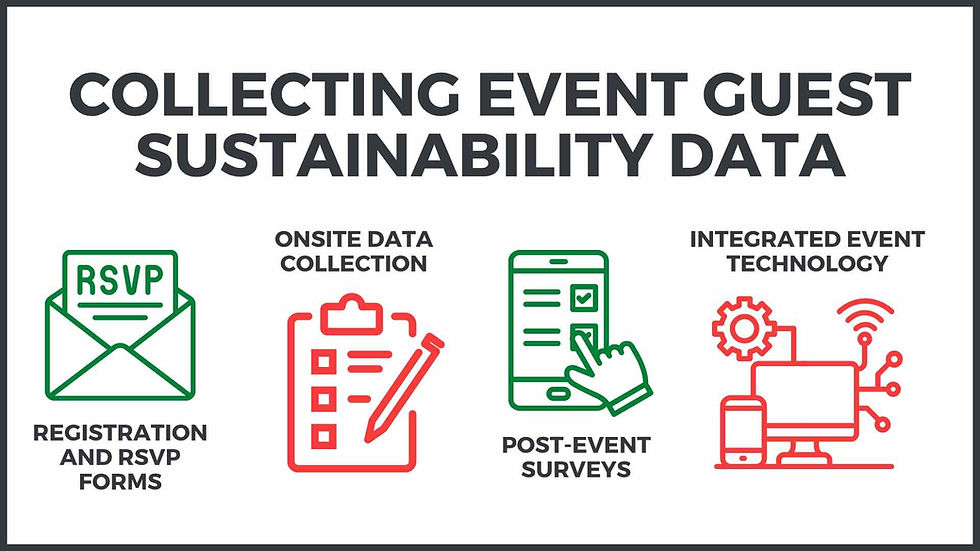
Registration And RSVP Forms
Registration is one of the easiest places to begin collecting attendee sustainability data.
Simple questions around travel plans, dietary preferences, and accommodation needs can help build an early sustainability picture before your event begins.
Onsite Data Collection
Live event data helps add accuracy to your reporting and is perfect for picking up attendee sustainability recommendations.
This might include:
Badge scans
Session attendance tracking
Catering usage
Waste monitoring
These insights help us understand what’s happening in real time.

Post-Event Surveys
Post-event surveys are a great way to fill in data gaps and validate any assumptions or estimations made earlier.
They’re also a great way to involve attendees directly in your sustainability journey and showcase your company's journey to be more sustainable.
Including a few simple follow-up questions around travel, catering and other core topics can provide valuable information for stronger future reporting.
Integrated Event Technology
As sustainability reporting grows, managing attendee data across multiple systems can quickly become difficult to keep on top of.
Registration platforms, badge scans, catering reports, venue data, and post-event surveys often sit in separate places, making it harder to build one clear view of your event’s sustainability performance.
Integrated event technology helps solve this by bringing everything together.
This allows organisers to:
Centralise all attendee sustainability data in one place
Automate data collection across multiple touchpoints
Reduce manual input and reporting errors
Build clearer attendee sustainability metrics over time
Create more reliable sustainability reporting
Having connected systems in place helps make measuring event sustainability feel much simpler, especially as reporting becomes more detailed.
This is where platforms like Scope help bring different data streams together, creating one clearer picture of your event guest sustainability data.
Attendee Sustainability Recommendations
If you’re just getting started be sure to take it one step at a time, it's much more important to focus on slow progress rather than perfection.
A few simple steps can make measuring event sustainability feel much more manageable once you've gotten started.

Prioritise Travel Data
Travel is often one of the most valuable places to begin due to how large the footprint tends to be.
Collecting information about where attendees are travelling from and how they’re getting to your venue creates a strong starting point for attendees carbon footprint reporting.
Once this process feels familiar, it becomes easier to expand into other areas.
Engage Attendees In The Process
Attendees are often happy to share sustainability information when they understand why it matters.
Simple messaging during registration or post-event surveys helps explain how their responses support stronger sustainability reporting.
This often improves participation while helping attendees feel included in the wider sustainability journey.
Build Accuracy Over Time
Many organisers begin with estimated data, and that’s completely normal.
Estimates create a useful starting point while more connected systems are being introduced.
Over time, improving data collection processes leads to more accurate reporting and stronger decision-making around your attendees carbon footprint.
How Scope Supports Event Sustainability Data And Reporting
Managing multiple sustainability data points manually can quickly become overwhelming.
Carbon tracking softwares such as Scope help to simplify the process by bringing key attendee sustainability metrics together across the full event lifecycle.
Our platform helps organisers:
Integrate multiple data inputs including travel, food and beverage, waste, and engagement
View reporting insights in real time
Combine both estimated and actual attendee sustainability data
Build clearer, more actionable sustainability reporting
Rather than working across disconnected spreadsheets and systems, Scope helps create one connected view of event guest sustainability data, making reporting easier to manage and easier to act on.

FAQ
Why Should Event Organisers Measure Sustainability Data?
Measuring sustainability data gives organisers a clearer understanding of how their event impacts the environment. By tracking areas such as attendee travel, food consumption, waste generation, and engagement patterns, organisers can build more accurate reporting, identify opportunities to reduce emissions, and make smarter sustainability decisions for future events.
What Are The Steps Involved In Measuring Carbon Footprint?
Measuring a carbon footprint usually follows four simple steps:
Collect data: Gather information across attendee travel, food choices, waste, and event engagement.
Organise and review: Bring this data together to create a clear picture of sustainability performance.
Calculate emissions: Apply recognised reporting frameworks and carbon factors to convert activity data into measurable outputs.
Identify opportunities to improve: Use insights to strengthen future sustainability strategies and improve reporting accuracy over time.
Can You Use Estimated Data For Sustainability Reporting?
Yes, many organisers begin with estimated data when first measuring sustainability performance. Accuracy can improve over time as reporting systems become more connected.
What Is The First Step In Measuring Attendee Carbon Footprint Data?
Travel data is often the best place to begin. It is usually easier to collect and often represents one of the largest areas of attendee-related emissions.
How Does Scope Support Attendees Carbon Footprint Reporting?
Scope brings attendee sustainability data together across travel, food, waste, and engagement metrics, helping organisers create clearer reporting and make more informed sustainability decisions.
Start Measuring Event Sustainability With Confidence
Attendee data plays an essential role in building stronger sustainability reporting.
Travel, food, waste, and engagement all contribute to a fuller understanding of your event’s sustainability performance.
While estimation can help create a starting point, long-term success comes from building more accurate and connected reporting processes over time.
The more complete your attendee sustainability data becomes, the easier it is to make informed decisions that support stronger event sustainability strategies.
Scope helps organisers manage multiple data streams in one place, making measuring event sustainability simpler, clearer, and more actionable.
If you’re ready to build more confident sustainability reporting, explore Scope’s tools or request a demo to see how connected attendee sustainability tracking works in practice.


Comments