


AI Carbon Footprint: What UK Businesses Need to Know
Artificial intelligence is becoming part of everyday business. From drafting emails and analysing reports to customer support and meeting summaries, AI tools are opening up new possibilities for how teams work.
As businesses explore these opportunities, it's also useful to understand the environmental impact of the technology behind them.
Every AI request relies on computing equipment, electricity and supporting infrastructure, all of which can contribute to greenhouse gas emissions. Together, these form part of what's known as the AI carbon footprint.
For UK businesses measuring and tracking their carbon emissions, understanding AI's environmental impact is another opportunity to build a clearer picture of their overall carbon footprint.
This guide explores where AI carbon emissions come from, how they relate to business carbon reporting and the practical steps organisations can take to understand their impact.

What Is the AI Carbon Footprint?
The carbon footprint of AI refers to the greenhouse gas emissions associated with developing, operating and supporting artificial intelligence systems.
These emissions arise at different stages, including manufacturing computer equipment, training AI models, processing everyday requests and operating the data centres that support them. Carbon footprints are generally expressed in carbon dioxide equivalent (CO₂e), which allows different greenhouse gases to be reported using a common measurement.
For businesses using tools such as ChatGPT, Microsoft Copilot or AI features within existing software, much of the technology operates through data centres managed by external providers. An employee might simply type a question into a browser, while the request is processed using computing infrastructure located elsewhere.
Understanding how these activities relate to business operations can help organisations build a more complete picture of their Scope 1, 2 and 3 emissions.
Where Do AI Carbon Emissions Come From?
The environmental impact of AI extends across different stages of its lifecycle. Looking at these stages helps explain why AI carbon emissions can vary between systems and activities.
Training AI Models
Before an AI model can generate responses, it generally goes through a training process involving substantial amounts of data and computing power. Training large models can require specialised processors operating over extended periods, using electricity supplied by the data centre.
The resulting emissions depend on the computing equipment, training process, electricity source and efficiency of the infrastructure. This means that training two different models won't necessarily produce the same carbon footprint.
Everyday AI Use
Once a model has been trained, it uses computing resources to process requests and generate outputs. This is known as inference.
For example, when an employee asks an AI assistant to summarise a document or draft an email, the model processes that request using computing equipment. Different tasks can require different amounts of computing power, so generating a short text response, analysing a lengthy document and producing a video are not equivalent activities.
As AI becomes part of more business processes, understanding how these tools are used can help organisations build a clearer picture of their associated emissions.

Data Centres and Cooling
Many AI services rely on data centres containing servers, networking equipment and supporting infrastructure. These facilities use electricity to operate their equipment, while cooling systems help maintain suitable conditions. Some cooling methods also use water, which means AI's environmental impact can extend beyond greenhouse gas emissions.
According to the International Energy Agency's Energy and AI report, global data centres consumed approximately 415 terawatt-hours (TWh) of electricity in 2024, representing around 1.5% of global electricity consumption.
The IEA's 2025 base-case projection suggests this could reach approximately 945 TWh by 2030, with AI a major contributor to the expected growth.
These figures cover all data centres, not just AI. They also describe electricity consumption rather than directly measuring greenhouse gas emissions.
Manufacturing AI Hardware
AI also relies on physical equipment, including servers, processors and networking infrastructure. Manufacturing these components requires materials, energy and transport, all of which can generate emissions before the equipment is used.
These are often called embodied emissions, referring to emissions associated with producing and supplying equipment. Considering both electricity consumption and equipment manufacturing provides a more complete understanding of AI's carbon footprint.
How Much Carbon Does Using AI Produce?
There isn't one figure that accurately describes the emissions associated with every AI request, as different tools and activities use different amounts of computing power.
The energy and emissions associated with an AI task depend on several factors, including:
The AI model and computing hardware being used.
The type and complexity of the request.
The length of the input and response.
The electricity supply supporting the data centre.
The activities included in the provider's calculation.
Some technology providers have started publishing their own estimates, helping to make this information more accessible.
In August 2025, Google published an assessment of the environmental impact of Gemini inference. It estimated that a median Gemini Apps text prompt used 0.24 watt-hours of electricity and generated approximately 0.03 grams of CO₂e, based on its specified methodology and measurement period.
These are provider-reported estimates for a particular service and period, rather than figures that can be applied to every AI tool or task. They also shouldn't be treated as a complete lifecycle carbon footprint for AI.
For businesses, understanding which AI services are being used and what information providers can share is often more useful than focusing on a single emissions figure per prompt.

Does AI Contribute to Your Business's Scope 3 Emissions?
AI services can contribute to a business's carbon footprint, and how they're accounted for depends on how the technology is provided.
If your organisation purchases access to an AI service hosted by another company, emissions associated with providing that service may fall within relevant categories of Scope 3 emissions. Scope 3 covers indirect emissions across a business's value chain, including certain purchased goods and services.
For organisations operating their own AI infrastructure, purchased electricity may fall under Scope 2, while hardware purchases and other indirect activities may be relevant to Scope 3. The appropriate treatment depends on the organisation's operational boundaries, supplier arrangements and accounting methodology.
For more information, explore our guide to what counts as Scope 3 emissions and the GHG Protocol's Scope 3 Standard.
A Practical Example: AI Across a Small Business
Imagine a business where the marketing team uses ChatGPT to develop content ideas, the sales team uses an AI meeting assistant and customer service uses an automated support tool.
Each department may have its own software subscription, with invoices showing the costs of these services. However, those invoices may not include information about the electricity or emissions associated with providing them.
The business can begin by bringing together its subscription records, identifying the relevant suppliers and checking what usage or emissions information is available. This creates a useful starting point for understanding how AI services fit into its wider carbon footprint, even when detailed supplier data isn't yet available.
How Can Businesses Begin Measuring Their AI Carbon Footprint?
Building an understanding of AI-related emissions can begin with information businesses already have, such as software subscriptions, supplier records and usage data.
From there, organisations can explore what additional information may be available and where estimates might be appropriate.
1. Identify the AI Tools Your Business Uses
Start by listing the AI services used across different departments. This may include standalone subscriptions, AI writing assistants, customer service tools, document analysis platforms and AI features included within other software.
Record the supplier, type of service, relevant subscription information and any available usage data. This provides a starting point for understanding which suppliers may be able to provide emissions information.

2. Understand What Each Service Involves
Different AI tools can involve different emissions sources and data requirements.
AI activity | Potential emissions sources | Information to investigate |
AI writing assistants | Computing and data centre operations | Supplier disclosures and usage records |
AI document analysis | Processing requests and supporting infrastructure | Service usage and provider methodology |
AI image or video generation | Computing used to generate media | Provider energy or emissions information |
Internally hosted AI | Purchased electricity, hardware and cooling | Electricity records and equipment information |
This table is a starting point for investigating relevant information, rather than a method for calculating emissions from individual activities.
3. Ask Suppliers for Emissions Information
Some AI and cloud providers publish environmental reports or service-specific emissions information. When reviewing this information, it's helpful to understand what the figures represent and how they've been calculated.
Useful questions include:
Does the information relate to the specific service we're purchasing?
Is it based on measured usage, modelling or estimates?
Does it include supporting data centre infrastructure?
Are emissions associated with hardware manufacturing included?
Can the figures be allocated to our organisation's usage?
What reporting period and methodology have been used?
A supplier's total company emissions cannot automatically be attributed to an individual customer's AI usage, so understanding the scope of the information is important.
4. Use Estimates Carefully Where Data Is Missing
Where supplier-specific emissions data isn't available, businesses can consider whether an appropriate estimation method is suitable. Depending on the circumstances, estimates may use activity information, supplier data or expenditure-based approaches.
For wider UK greenhouse gas accounting, the government publishes annual greenhouse gas conversion factors, which help organisations calculate emissions from relevant activity data.
However, these factors are not a dedicated method for calculating emissions from individual AI prompts or subscriptions. Any estimate should use an appropriate methodology, with assumptions and limitations clearly recorded.
For further guidance, explore our articles on estimating carbon emissions and how emission factors work.
5. Consider AI Within Your Wider Carbon Footprint
AI is one part of a business's overall emissions picture. Depending on the organisation, electricity, transport, purchased goods, business travel and other activities may also contribute to its carbon footprint.
Looking at AI-related emissions alongside other business activities can help organisations develop a more complete understanding of their environmental impact.
Our guide to five carbon data sources most businesses already have explains where useful information may already exist.
As supplier information improves, businesses can revisit their assumptions and refine their estimates. We've also covered this in how to improve your carbon data over time.

Do UK Businesses Have to Report AI Carbon Emissions?
There is no general UK requirement for every business to produce a separate report on the carbon footprint of its AI tools.
However, some organisations have wider greenhouse gas reporting obligations, and relevant emissions from purchased digital services may need to be considered within their reporting boundaries.
In September 2026, the Financial Conduct Authority published updated sustainability reporting rules for certain listed companies, aligning disclosures with the UK Sustainability Reporting Standards.
According to the FCA's sustainability reporting requirements, the rules apply to accounting periods beginning on or after 1 January 2027 on a comply-or-explain basis, with transitional provisions including relief relating to Scope 3 disclosures.
This doesn't create a universal AI-specific reporting requirement, and the rules don't apply to every UK business.
For a wider overview of UK reporting obligations, see our guide to ESG reporting requirements in the UK and Europe.
Can Businesses Reduce Their AI Carbon Emissions?
Understanding how AI tools are used can help businesses identify opportunities to review their technology choices and processes.
For example, teams might consider whether multiple subscriptions serve the same purpose, whether automated tasks are useful or whether suppliers provide meaningful information about the energy and emissions associated with their services.
Businesses can also review supplier disclosures relating to electricity sourcing, infrastructure efficiency and environmental reporting. These considerations can inform purchasing and operational decisions, although any claimed carbon reductions should be supported by evidence.
AI itself may also support activities intended to improve energy efficiency or operational planning, depending on how the technology is used.
The important distinction is between understanding emissions, identifying opportunities to take action and demonstrating that reductions have actually occurred.
How Scope Can Help You Understand Your Business Carbon Footprint
For businesses measuring their emissions, AI is one example of how environmental information can be spread across different suppliers and activities.
Electricity bills, travel records, software subscriptions and supplier invoices can all provide useful information when building a wider understanding of business emissions.
At Scope Carbon Tracking, our focus is on helping organisations measure and track their carbon emissions, providing a more structured approach to understanding business activities.
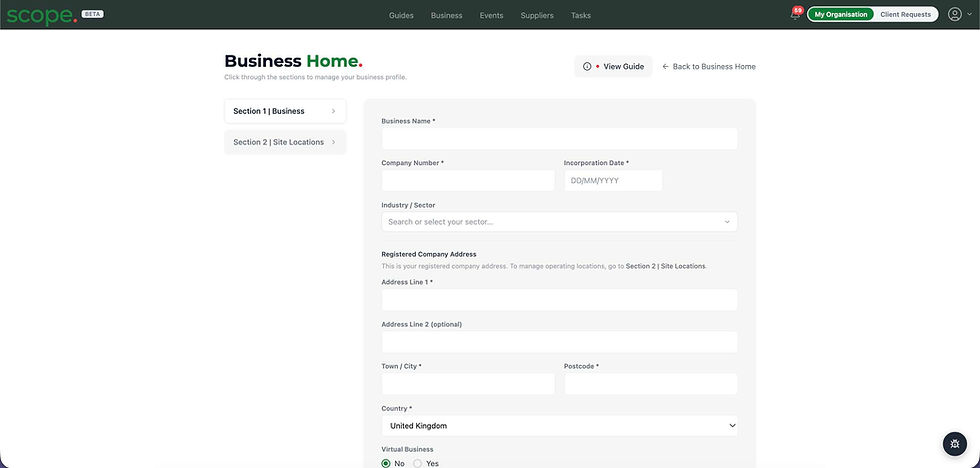
Our Business Carbon Tracking offering supports businesses looking to approach emissions measurement more systematically.
If you're at an earlier stage, you can also explore the Scope Business Carbon Calculator to begin understanding your wider business carbon footprint.
Understanding the Bigger Picture
AI is creating new possibilities for businesses, and understanding its environmental impact can be part of making informed decisions about how the technology is used.
The carbon footprint of AI can include emissions associated with training models, processing everyday requests, operating data centres and manufacturing computing equipment.
For UK businesses, a useful starting point is to understand which AI services they use, what information suppliers can provide and how those activities fit into their wider carbon footprint.
By starting with the information available today and building on it as more detailed data becomes accessible, organisations can continue developing a clearer understanding of their emissions and make informed decisions about their next steps.


Comments