


Business Carbon Footprint Calculator: How To Calculate Your Company's Emissions
Updated: Sep 23
If you've searched for a business carbon footprint calculator, chances are you're looking for a simple way to understand your company's environmental impact.
Whether you're responding to customer requests, preparing for sustainability reporting, working towards net zero or simply trying to make more informed business decisions, measuring your carbon emissions is often the first step.
The challenge is knowing where to begin.
Many businesses assume they'll need consultants, spreadsheets or weeks of data gathering before they can calculate their emissions. In reality, getting started can be much simpler with the right approach and the right tools.
In this guide, we'll explain what a business carbon footprint calculator is, what information you'll need, how calculations work, and how carbon accounting software can help you move beyond simply measuring emissions to actively reducing them.

What Is A Business Carbon Footprint Calculator?
A business carbon footprint calculator is a tool that estimates the greenhouse gas emissions produced by your organisation.
It converts information about your business activities into a carbon dioxide equivalent (CO₂e), giving you a clearer picture of where emissions are coming from.
Depending on the calculator, this might include:
Electricity consumption
Gas usage
Company vehicles
Business travel
Employee commuting
Purchased goods and services
Waste and recycling
Water consumption
Freight and logistics
Rather than simply producing a single number, a good business carbon footprint calculator helps identify the activities creating the greatest impact, making it easier to prioritise meaningful reductions.
Why Should Businesses Calculate Their Carbon Footprint?
Carbon accounting is no longer something only large corporations need to think about.
Businesses of every size are increasingly being asked about their environmental impact by clients, investors, procurement teams and supply chain partners.
Understanding your emissions can help you:
Prepare for sustainability reporting
Support ESG objectives
Meet customer expectations
Identify opportunities to reduce operational costs
Improve efficiency
Set realistic carbon reduction targets
Monitor progress over time
For many organisations, calculating emissions also provides valuable insights into everyday business operations that may otherwise go unnoticed.

What Information Do You Need To Calculate Your Business Carbon Footprint?
The quality of your results depends on the quality of the information you collect.
Most business carbon calculators will ask for data across several operational areas that lots of businesses will already have data for.
Energy Consumption
Energy is often one of the easiest places to start.
This typically includes:
Electricity usage
Natural gas
Heating fuels
Renewable energy purchases
Your utility bills usually contain most of the information you'll need.
Company Vehicles
If your organisation owns or operates vehicles, you'll normally need details such as:
Fuel type
Mileage
Fuel purchased
Vehicle types
Business Travel
Business travel can quickly become a significant source of emissions.
This may include:
Flights
Rail journeys
Hotel stays
Hire cars
Taxis
Keeping accurate travel records throughout the year makes reporting much easier.
Employee Commuting
Many businesses now choose to estimate emissions created by employees travelling to and from work.
This may include:
Average commuting distance
Mode of transport
Office attendance patterns
Remote working arrangements
Purchased Goods And Services
For many organisations, purchased products and services contribute a large proportion of total emissions.
Examples include:
Office equipment
IT hardware
Professional services
Manufacturing materials
Packaging
Marketing materials
Waste
Recording waste by type allows businesses to understand where unnecessary emissions are being generated.
Typical categories include:
General waste
Recycling
Food waste
Confidential waste

Understanding Scope 1, Scope 2 And Scope 3 Emissions
Business carbon footprint calculations are generally organised into three categories - Scope 1, 2 and 3 - defined by the Greenhouse Gas Protocol.
Scope 1
These are direct emissions produced by assets your organisation owns or controls.
Examples include company vehicles, boilers and onsite fuel use.
Scope 2
These are indirect emissions created by purchased electricity, heating or cooling.
Although the emissions occur elsewhere, they're generated because your business uses that energy.
Scope 3
Scope 3 includes emissions across your wider value chain, and sometimes can be harder to understand what counts as Scope 3.
This generally covers:
Business travel
Employee commuting
Purchased goods
Waste
Freight
Supplier activities
For many organisations, Scope 3 represents the largest proportion of total emissions, but it's important to understand Scope 1, 2 and 3.
Understanding all three scopes creates a far more complete picture of your environmental impact than focusing on energy alone.
Are Free Business Carbon Footprint Calculators Accurate?
Free calculators can be an excellent place to start.
They help businesses understand the scale of their emissions and introduce the principles of carbon accounting without requiring a significant investment. However, they also have limitations.
Many free calculators rely on estimates rather than detailed operational data.
Some only calculate a handful of emission sources, while others don't allow businesses to monitor progress over time.
As organisations become more confident in carbon reporting, they often require additional functionality such as:
Detailed reporting
Team collaboration
Supplier engagement
Historical comparisons
Reduction planning
Audit-ready reporting
This is where dedicated carbon accounting software becomes valuable.
Why Spreadsheets Eventually Become Difficult
Many organisations begin by tracking emissions in Excel.
While spreadsheets work for simple calculations, they quickly become difficult to manage as businesses grow.
Common challenges include:
Manual calculations
Version control
Missing information
Inconsistent methodologies
Difficult collaboration
Limited reporting
Over time, maintaining accurate spreadsheets often takes considerably more effort than using dedicated software designed specifically for carbon accounting.
How Carbon Accounting Software Makes Calculating Emissions Easier
Modern carbon accounting software does far more than calculate emissions.
It creates one central location where businesses can collect data, monitor progress and identify opportunities for improvement.
Rather than manually combining information from finance teams, suppliers and facilities managers, businesses can centralise their environmental data in one place.
This makes it easier to:
Track Scope 1, 2 and 3 emissions
Identify emission hotspots
Produce consistent reports
Compare performance year after year
Support sustainability reporting
Plan carbon reduction strategies
Instead of treating carbon reporting as a once-a-year exercise, organisations can make sustainability part of everyday decision making.
How Scope Helps Businesses Calculate Their Carbon Footprint
At Scope, we believe carbon accounting should be accessible to every organisation, including smaller SMEs.
Our business carbon footprint calculator is designed to make measuring emissions straightforward, whether you're calculating your footprint for the first time or building a long-term sustainability strategy.
With Scope, businesses can:
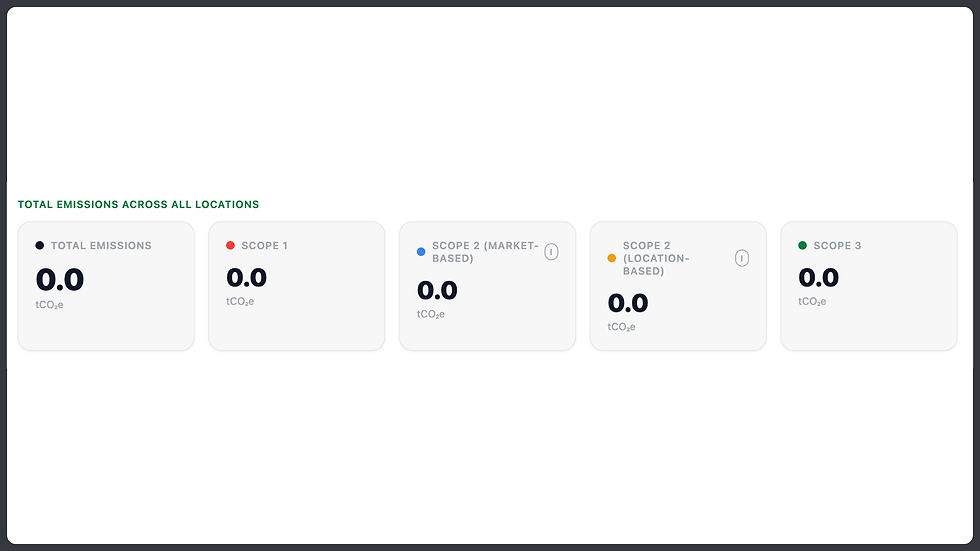
Record emissions across Scope 1, 2 and 3
Collaborate with colleagues and suppliers
Monitor performance over time
Identify the biggest sources of emissions
Build credible sustainability reports
Turn environmental data into practical action
As your sustainability journey develops, your reporting can grow with you.
Whether you're tracking day-to-day business operations or measuring emissions from events, Scope brings everything together in one intuitive platform.
Start Measuring Your Business Carbon Footprint Today
Every sustainability journey starts with understanding where your emissions come from.
A business carbon footprint calculator gives you the knowledge to make informed decisions, improve reporting and uncover opportunities to reduce both emissions and operational waste.
Rather than relying on estimates or complicated spreadsheets, modern carbon accounting software helps businesses build a clearer picture of their environmental impact and take meaningful action.
If you're ready to start measuring your company's emissions, Scope Carbon Tracking makes the process simple, collaborative and built for businesses of every size.
Create your free account on our business carbon calculator and take the first step towards smarter carbon accounting.
Frequently Asked Questions
What is a business carbon footprint calculator?
A business carbon footprint calculator estimates the greenhouse gas emissions produced by your organisation based on activities such as energy use, travel, waste and purchased goods.
How do you calculate a business carbon footprint?
Most businesses calculate their carbon footprint by collecting operational data and applying recognised emission factors to convert that information into carbon dioxide equivalent (CO₂e). Carbon accounting software automates much of this process.
Can small businesses calculate their carbon footprint?
Yes. Businesses of any size can calculate their carbon footprint. Many start with a free business carbon footprint calculator before moving to more comprehensive carbon accounting software as reporting requirements grow.
What is the difference between a carbon calculator and carbon accounting software?
A carbon calculator usually provides an estimate of emissions. Carbon accounting software helps businesses continuously collect data, monitor performance, generate reports and identify opportunities to reduce emissions over time.
Is a business carbon footprint calculator free?
Many business carbon footprint calculators offer free versions that allow organisations to begin measuring emissions. As businesses require more detailed reporting and collaboration features, they often move to dedicated carbon accounting platforms like Scope.


Comments